Becas del Colegio St. Augustine

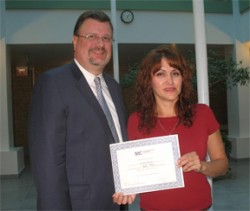
Lawndale News Chicago's Bilingual Newspaper - EducacionLaura Méndez, residente de Whiting, Indiana, siempre quiso continuar su educación universitaria, pero limitaciones económicas y la responsabilidad de criar una familia siempre se interpusieron en su camino. Hasta que recibió una llamada, el 16 de agosto y supo que había ganado una beca de $8,750 para estudiar en St. Augustine College. “¡Mi familia y yo no podíamos creerlo! Ya me inscribí en el programa de Psicología y estoy muy contenta de poder continuar con mi educación”, declaró Méndez.

La Universidad St. Augustine acaba de concluir otra exitosa campaña de reclutamiento para el semestre de otoño y ya está tomando registros para la próxima rifa de una beca de $8,750, que tendrá lugar a principios de enero del 2013.

“Felicitamos a Laura y le damos la bienvenida en el St. Augustine. Invito a todas las personas interesadas en continuar su educación a que se informen sobre nuestros programas y los cursos de GED que se ofrecen completamente gratis en nuestros cuatro locales en Chicago”, dijo Andrew C. Sund, Presidente de St. Augustine College. Para más información sobre St. Augustine o para inscribirse para ganar una beca, llamar al 773-878-8756 o visitar www.staugustine.edu.

Good Judgement, Bad Judgement

By: Daniel Nardini

Lawndale News Chicago's Bilingual Newspaper - Commentary A federal judge ruled that Texas’ voter identification (ID) law is unconstitutional, and that it is discriminatory against racial and ethnic minorities as well as low-income families. A month before, a state judge let stand Pennsylvania’s ID law, saying that it is constitutional. The State of Texas and the plaintiffs in a lawsuit against the State of Pennsylvania filed by the American Civil Liberties Union will appeal these judgements. It is very clear that these two judgements stand in contrast to each other, and the whole issue of whether voter ID laws are constitutional may go all the way to the U.S. Supreme Court. Republican presidential candidate Mitt Romney supports these laws while current U.S. President Barack Obama stands against these laws. The Republicans, the ones who have mainly voted for these voter ID laws, believe that it will prevent fraud at the ballot box. Democrats and many independents contend that it is a way of keeping people from voting, thus affecting the election results.

One thing is clear, many people are being prevented from voting in this upcoming election because of these voter ID laws. According to the Brennan Center for Justice, which tracks voting rights, as many as five million people will not be able to vote because of these voter ID laws. The ones who will be most affected are ethnic and racial minorities, low-income residents, and the disabled. Many of these residents live in areas where getting state identification cards and driver’s licenses is difficult if not next to impossible. And where these identification cards are available, many state residents may have problems getting them because the states that have passed voter ID laws require many documents that state residents do not have. Worse, many residents cannot afford the expenses of getting these cards or the documentation required. Some Democratic legislators are trying to streamline the process in a number of states to help those who cannot get state ID cards or driver’s licenses.

But the main problem is that these state ID laws that had gone into effect in Texas, Florida, South Carolina, Pennsylvania, Rhode Island, Mississippi, Kansas, and Wisconsin. Alabama and Tennessee have already tightened their voter ID laws. Many federal and state officials contend that voter fraud is rare, and that there are already safeguards in place to deal with voter fraud. That such restrictive ID laws have come into place seems more in the interests of some to restrict voting more than to stop voter fraud. These two arguments—voting rights as well as voter fraud—are now playing out in courts in various states. The decisions being made are as contrary and contradictory as enforcement of these laws. Since we are seeing voter ID laws being held constitutional as well as unconstitutional, this whole argument may very much end up at the U.S. Supreme Court. What is scary is if these laws will indeed curtail voter access during this upcoming presidential election, thus changing the results of who will be president?

CPS Welcomes Students on First School Day

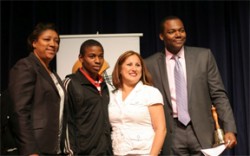
Lawndale News Chicago's Bilingual Newspaper - EducationChicago Public Schools (CPS) CEO Jean-Claude Brizard, CPS Board Members, Representative Cynthia Soto, and members of the CPS leadership team joined Track R school communities across the District to launch the new school year and the Full School Day. “This is a momentous day in the history of CPS as every child throughout Chicago now has access to a quality school day and year, putting them on a path to success in school and life,” said CPS CEO Jean-Claude Brizard, who welcomed students to their first Full School Day and rang the school bell at Roberto Clemente Community High School.

With the additional time provided by the Full School Day, all students at Clemente are receiving the equivalent of an additional full class period in math and English four days a week. Students who are on track to graduate at Clemente are also receiving an additional class period of enrichment including fine arts, health and wellness, AP supports, medical science and photography, and recovery options are now available to those who need extra help to get back on track to graduate.

Students, Parents, and Teachers Journey to Washington, D.C. for Justice

Lawndale News Chicago's Bilingual Newspaper - EducationA national alliance covering 18 states will converge on Washington, D.C. on September 20th to send a message that for the need for sustainable, community-driven school reform, not shuttering public schools and brokering them to private operators. Thousands are expected to march and sit-in at the U.S. Department of Education where they will seek an audience with President Barack Obama and U.S. Secretary of Education Arne Duncan.

Those community organizations, student groups, parents and teachers are from several cities including Chicago, Detroit, Oakland, Los Angeles, and Newark to name a few. Many of these cities have filed Title VI civil rights complaints against their school districts regarding the racial impact of school closings, turnarounds, phase-outs, co-locations and other drastic actions. These organizations have pushed the U.S. Department of Education Office of Civil Rights to open investigations at schools in New York, Boston, Washington, D.C., Wichita, KS, Oakland and Chicago. “Closing schools destroys communities and the research backs up what we already know. It doesn’t work. It is time tested, and flawed,” said a teacher based in New York. The research backs up this claim. Since 2002 in Chicago, only 18 percent of the schools that have replaced closed schools are high performing. Of that 18 percent, half are selected enrollment. Half of the replacement schools are Level 3, CPS’ lowest rating (Chicago Catalyst, Dec. 7th, 2011).

Due to pressure from this alliance, the Dept. of Education has agreed to National Grassroots Impact Tours in many cities throughout the U.S. this fall, culminating in a federal hearing on these issues in January. “We know this is a violation of our civil rights,” said Diamond McCullough, a high school junior from Chicago. “My high school was sabotaged by CPS. Last year, we had to take art online. CPS cut our most successful programs, and then watched us struggle. We are riding to D.C. to let America know. I am supposed to be preparing for my ACT test and I am fighting for my educational life.”

An Old File Case

By: Daniel Nardini

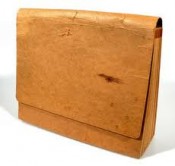
Lawndale News Chicago's Bilingual Newspaper - CommentaryWhen my wife returned from school, she brought back a very big sort-of suitcase made of leather and cardboard. It had a sturdy handle and brass clasps. According to my wife, it had been discarded and left at the free books section. I knew what the item was. It is what we call a file case. Similar to a brief case except this was used by professors, academics and even office workers at college for storing their papers. And since professors possessed lots of papers, they needed a fairly large case. The file case served this purpose. We will never know who used to have this file case, and we will never know who previously owned it (since there was no name on it).

We do know that something like this is no longer used, and no longer desired. No one really needs such a thing anymore since all official school records are now being kept on computer. All students (and even many professors) just store their homework, their class schedules, their notes, and even their textbooks on their iPads, their iPhones, their Samsung Three Galaxy phone, etc. There are still students who bring all their books in their backpacks, but a growing number of students are using their online access to read their texts and also use audio and video for class lectures. No longer do so many people need to store books or papers for anything. No longer do people have to physically write papers on paper, and no longer do students have to physically submit actual paperwork (they can do all of this online).

Because of all this, what is the point of a file case? If actual paperwork is no longer needed, then a file case is simply no longer needed. It is going the way of the old analog TV set, the wristwatch, the physical paper book, the corded rotary phone, and the wind-up alarm clock. These things have become or are becoming museum pieces that many young people are just unfamiliar with, and see no point to anymore. Well, I am keeping the file case for all of the newspapers in my house. Oh yes, someday the physical newspaper will also be as much an unwanted museum piece as the file case.

St. Augustine College Awards Scholarship

Lawndale News Chicago's Bilingual Newspaper - Education
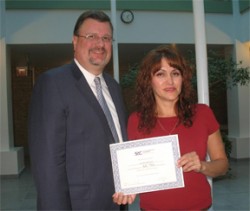
Andrew C. Sund, President of St. Augustine College, and Laura Méndez, scholarship winner.
Laura Méndez, a resident of Whiting, Indiana, always wanted to continue her college education, but economic limitations and the responsibility of raising a family always got in the way. Until she received a call on August 16th and learned that she won an $8,750 scholarship to study at St. Augustine College. “My family and I could not believe it! I already enrolled in the Psychology program and am very happy to continue my education,” declared Méndez.

St. Augustine University just concluded another successful recruitment campaign for the Fall semester and is already taking registrations for the next drawing of an $8,750 scholarship, which will take place in early January, 2013.

“We congratulate Laura and welcome her to St. Augustine. I also invite anyone interested in continuing their education to learn about our programs and about our GED courses, which are offered completely free at our four Chicago locations,” stated Andrew C. Sund, President of St. Augustine College. To learn more about St. Augustine or to register to win the scholarship, call 773-878-8756 or visit www.staugustine.edu.

CPS Recibe a los Estudiantes en su Primer Día de Clases

Lawndale News Chicago's Bilingual Newspaper - EducacionEl CEO de las Escuelas Públicas de Chicago (CPS), Jean-Claude Brizard, los Miembros de la Junta de CPS, la Representante Cynthia Soto y los miembros del equipo de liderazgo de CPS se reunieron con las comunidades escolares del distrito para iniciar el nuevo año escolar y el Día Completo de Escuela. “Este es un día memorable en la historia de CPS, ya que todos los niños de Chicago tienen ahora acceso a un día y un año de escuela de calidad, lo que los coloca camino al éxito, en la escuela y en la vida”, dijo el CEO de CPS, Jean-Claude Brizard, quien recibió a los estudiantes en su Día Completo del Escuela y tocó la campana escolar en la Secundaria Comunitaria Roberto Clemente.

Con el tiempo adicional provisto por el Día Completo del Escuela, todos los estudiantes de la Clemente reciben el equivalente de un período completo de clases adicionales en matemáticas e inglés, cuatro días a la semana. Los estudiantes que están camino a graduarse en la Clemente reciben también un período adicional de enriquecimiento, incluyendo bellas artes, salud y bienestar, apoyo AP, ciencias médicas y fotografía y opciones de recuperación ahora disponibles a todo el que necesite ayuda extra para retomar el camino a la graduación.

Urban Initiatives Kicks Off 10th Year of ‘Work to Play’

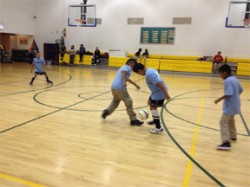
Lawndale News Chicago's Bilingual Newspaper - EducationUrban Initiatives kicked off the new school year right with Dr. Jorge Prieto Math and Science Academy’s first Work to Play practice on the first day of school with sixty minutes of physical activity and a discussion on Health and Character, ending with a healthy snack.

The Work to Play program calls on 1st-4th graders to be leaders in the classroom and on the soccer field through weekly Health and Character lessons. It has been proven that participants of the Work to Play program have a higher attendance rate and on-time arrival to school than those students not enrolled with Urban Initiatives programming.

Urban Initiatives is a nonprofit organization that runs a health and education soccer program, called the Work to Play Program, in the Chicago Public Schools. To learn more about the program, visit www.urbaninitiatives.org.

Viaje de Estudiantes, Padres y Maestros a Washington, D.C., en pro de Justicia

Lawndale News Chicago's Bilingual Newspaper - EducacionUna alianza nacional, cubriendo 18 estados, convergerán en Washington, D.C., el 20 de septiembre, para enviar el mensaje de la necesidad de una reforma escolar sustentable, impulsada por la comunidad y no del cierre de escuelas ni el entregarlas a operadores privados. Se espera que miles marchen y permanezcan en el Departamento de Educación de E.U., donde esperan una audiencia con el Presidente Barack Obama y el Secretario de Educación de E.U. Arne Duncan.

Estas organizaciones comunitarias, grupos estudiantiles, padres y maestros, vienen de varias ciudades, incluyendo Chicago, Detroit, Oakland, Los Angeles y Neward, por nombrar algunas. Muchas de estas ciudades han puesto quejas de derechos civiles Título VI contra sus distritos escolares, sobre el impacto racial del cierre de escuelas, reestructuraciones, eliminaciones, colocaciones y otras acciones drásticas. Estas organizaciones han pugnado con el Departamento de la Oficina de Educación de Derechos Civiles de E.U., para abrir investigaciones en escuelas en Nueva York, Boston, Washington, D.C., Wichita, KS, Oakland y Chicago. “El cierre de escuelas destruye las comunidades y las investigaciones respaldan lo que ya sabemos. No funciona”, dijo un maestro de Nueva York. Las investigaciones respaldan este reclamo. Desde el 2002 en Chicago, solo el 18 por ciento de las escuelas que han reemplazado escuelas clausuradas tienen un buen desempeño. De ese 18 por ciento, la mitad son de inscripción selecta. La mitad de las escuelas reemplazadas son Nivel 3, el índice más bajo de CPS (Chicago Catalyst, 7 de Dic, del 2011).

Debido a la presión de esta alianza, el Dept. de Educación ha estado de acuerdo en Giras Nacionales de Impacto en muchas ciudades de E.U., este otoño, culminando, en enero, con una audiencia federal sobre estos temas. “Sabemos que esto es una violación a nuestros derechos civiles”, dijo Diamond McCullough, estudiante junior de secundaria de Chicago. “Mi secundaria fue saboteada por CPS. El año pasado tuvimos que tomar arte en línea. CPS cortó nuestros mejores programas y luego nos vio luchar. Nos dirigimos al D.C., para que Estados Unidos lo sepa. Yo estoy supuesto a estar preparándome para mi prueba ACT y estoy luchando por mi edu

Cómo Solicitar Discapacidad en el Seguro Social

Por: Ashmar Mandou

Lawndale News Chicago's Bilingual Newspaper - SaludSolicitar Discapacidad en el Seguro Social puede ser algo complicado y abrumador si no sabe como hacerlo apropiadamente. “Hay mucha información sobre como llenar apropiadamente los papeles para Discapacidad en el Seguro Social, pero la gente, especialmente la comunidad latina, no tiene idea de por donde empezar”, dijo la Dra. Yolanda Ayubi,directora ejecutiva de Dr. Ayuby and Associates Social Security Disability Advocates.

En la década pasada, la Dra. Ayubi ha visto muchos errores en las solicitudes, lo que la hizo comenzar a trabajar en un libro enfocado en Discapacidad en el Seguro Social y como impacta a la ‘comunidad étnica’, dijo la Dra. Ayubi. “Para que la gente solicite discapacidad, primero necesitan probar que están discapacitados y para hacerlo necesitan ver a un doctor”, dijo la Dra. Ayubi. “Este paso es particularmente importante y es ahí donde muchas veces hay falta de comunicación”. Con eso dicho, la Dra. Ayubi recopiló una lista de cinco puntos de lo que se necesita hacer antes de solicitar Discapacidad en el Seguro Social. La lista es la siguiente:

  • Usted no está trabajando
  • Está viendo a un doctor
  • Su enfermedad lo discapacita
  • No puede hacer el trabajo que hacía antes
  • No puede trabajar y necesita ayuda de otros

“Es sumamente importante que la gente reúna toda la información que pueda referente a su salud”, dijo la Dra. Ayubi. “Documente cada síntoma, cada dolor, cada visita al doctor y haga tantas preguntas como pueda. Escuche también que necesita el doctor de usted, como paciente”.

Para más información sobre como empezar, visite www.ssa.gov/disbility. O llame a Dr. Ayubi and Associates al 312-912-7122 para ver si califica.