By: Ashmar Mandou
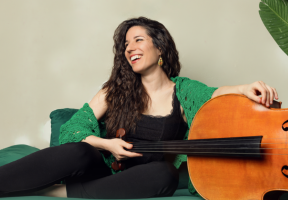 GRAMMY nominated cellist and composer Andrea Casarrubios is set to debut her latest piece of work which reflects on the power of silence as part of the Nova Linea Musica (NLM) showcase on December 3rd at Guarneri Hall. “I am looking forward to debuting this new piece of work and I’m excited to work with the Catalyst Quartet and be part of the Nova Linea Musica showcase,” said Casarrubios. NLM is an innovative local chamber of music series and new music incubator that presents concerts throughout the year. This winter, NLM will feature two new world premieres, first with internationally acclaimed Catalyst Quartet with music that explores ‘resistance in the face of adversity’ tilted Against All Odds, with the help of composer Casarrubios who, commissioned by NLM, created a piece of work entitled, Unsaying that dissects the power of silence. We highlight the talented artist, Casarrubios who discusses the inspiration behind her new piece of work, her methods, and how hard work pays off.
Lawndale News: You will showcase your new piece of work as part of the Nova Linea Musica showcase. What served as the inspiration for your work, Unsaying?
Andrea Casarrubios: It was a challenge to write something brief that could have a lot of weight and meaning and relevance. So, I thought a lot about silence, about the paradox of silence. The music captures words withheld as crucial moments. It’s full of fear. On the surface it might seem beautiful, it might seem even inviting, but there’s a lot of tension and fear underneath. For example, when fear overwhelms the impulse to speak. In the center, or the main element of this work is a grande pause, like a silence that feels like weight. I feel like that’s the most important part of this piece. The music might have a potential of violence and power, but it’s very much not heard. It’s sort of beautiful on the surface, as I said, with a sort of danger underneath.
LN: I always find it fascinating that composers such as yourself can take the pinnacle of emotions and somehow translate that through music. Can you talk to me about the development or the process or musical ideas that you go through to create a piece of music?
AC: I would say it really depends on each situation, each piece. For this specific one, for example I was very much…I mean, I think we are all influenced by how we live, where we live, everything we are experiencing in history in society, with each other. So, this is very much part of that, but there’s a certain moment where I must go inwards and take the path on my own, if that makes any sense. For example, in this piece there’s a moment in the beginning where a month or so I do a little research. I will listen to the people that I have to write about, I will think about their personalities, I will think about the place in the music world or their place in society, their message. I will consider a lot of aspects of their humanity in their music making and then I will start with distilling the most essential, the most important and truthful part of what I am considering. So, in this case, the concept of saying or unsaying or silence; the concept had to do not just with silence but the violence of choosing not to speak. From that concept then comes the music and that is maybe the most solitary process. I take a lot of walks. When I’m writing I try to lead a very simple life.
Q: You have such an extensive career, so I am very curious to know if you remember the moment or piece of music that impacted your decision to become a composer and cellist?
AC: That’s very interesting. You know my career …I love the way that it has unfolded and I am very grateful for it because for so long I placed a lot of emphasis on being a cellist. That’s what I was mostly known for, and it allowed me to play with magnificent artists. From the aspect of being a cellist and composer, I would say early on when I was in my teenage years hearing [Franz] Schubert’s String Quintet for two cellos…maybe that was one of the most relevant experiences. It was the vastness and the human connection, the emotional connection to the music…I think that was one of the turning points, for me. That’s what impacted me the most in my career.
LN: For young Latinos who aspire to follow in your footsteps, what advice do you have for them?
AC: That’s a tough answer because everybody is so different, everyone has different needs and aspirations. For me, I’ve had work three times as hard. I’ve had to study three times as hard. I’ve had to put in triple the effort. Even though that’s tricky at times, I’m also very grateful for it. It’s the values that I’ve learned through doing all of that…it has been valuable. And to have the capacity to do all of that at once; I think it comes in handy. Effort is a good thing to learn, and I think no matter where you come from, hard work is a good thing to learn, no matter who you are.
For more information or for tickets, visit www.novalineamusica.org.
Photo Credit: Nova Linea Music