By: Ashmar Mandou
 As we honor Mental Health Awareness Month, the Chicago Department of Public Health (CDPH) revealed the next phase of its Mental Health Equity Initiative (MHEI), the Healthy Chicago Mental Health Collective (HC-MHC). HC-MHC is designed to enhance collaboration among mental health providers, bring increased resources to underserved communities, and close the city’s life expectancy gap. HC-MHC will work with community partners, such as Gads Hill Center, La Rabida Children’s Hospital, and Alivio Medical Center Inc., to tailor treatment to the most vulnerable populations, such as high-risk children and youth, human trafficking survivors, people living with HIV/AIDs, people with serious mental illness and substance use, and people with complex medical and social needs. Director of Behavioral Health Program Operations at CDPH Katherine Calderon expounded on the significance of the new phase and how the new initiative will improve access to mental health services.
Lawndale News: Can you share the significance of Chicago Department of Public Health’s new phase of the Mental Health Equity Initiative?
Katherine Calderon: We are excited to launch this rendition of the Healthy Chicago Mental Health Collective. We have been working as a mental health department, building out our mental health initiatives for the past five years. Also, we have been serving the community through our clinics for longer than that and this project marks an expansion and evolution of our mental health initiatives overtime. I think some key aspects include funding more partners, who are doing innovative work in addressing gaps and services where we see the greatest need. Both geographically but also among populations that I think historically don’t get the mental health services they need…and then we are also integrating all this work with our own direct services, such as our city run clinics.
LN: How does this new initiative improve access to mental health care for Chicagoans?
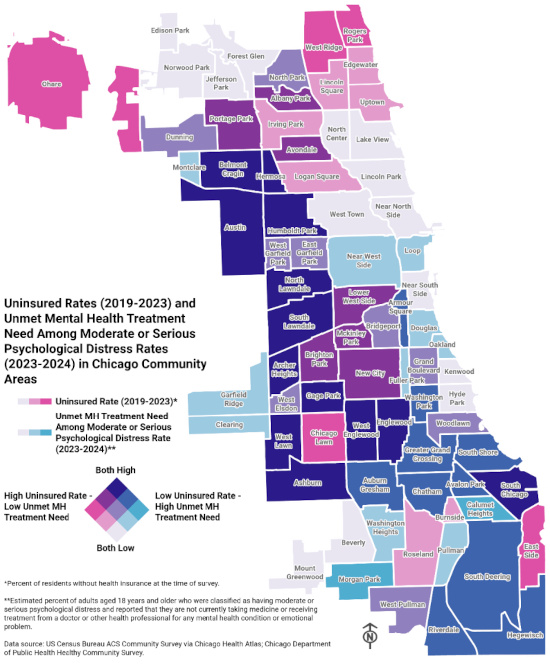
KC: For this project we have developed a tiered system within the city. We could look at the intersection of lack of health insurance and high unmet mental health needs, and triage getting more resources to those areas. So, the hope would be that not only are we uplifting and leveraging the existing services in the community but also making sure that we can expand those services in those areas. The hope would be that Chicagoans across the city can get access to services easier at different touchpoints through their doctor, their community, at the clinic setting depending on their preference, but that those services are available in communities where we see more need.
LN: Part of the key elements includes integrated care coordination. How does that look when put into practice?
KC: Integrated care is considered a holistic approach to an individual. It would be looking into all their needs versus treating a certain aspect of what they might need. If someone might present with a mental health issue as well as a health issue and may have some issues with social drivers of health, then integrated care would allow for multiple staff and personnel within an agency to be able to respond to those needs in a way that is seamless for the individual. In our clinic setting at CDPH, we provide psychiatric services, therapy services, case management, and nursing. So integrated care within our settings would be, for example, a client can come in through the door for a variety of needs and then be able to have our staff respond to all of that based on assessment and the resources that we have available.
LN: How can residents access services through the HC-MHC network?
KC: We have a map on our website that provides all the sites for the locations of our partners. We are building a partnership with NAMI Chicago, and they will be leveraging their hotline to help their call takers sort of connect people to the different partners. To learn more about the new initiative and HC-MHC services, residents can visit www.chicago.gov.
A total of $16.2 million is being invested through a combination of corporate funds, Opioid Settlement Funds, and Ryan White Part A funds to support this work. Highlights of the expansion include:
• Community-Collocated Providers: Deliver mental health services in settings collocated with other medical and social services (such as libraries and food pantries). This integrated approach reduces barriers to care and supports person-centered mental health care alongside other essential services.
• Clinic-Based Providers: Provide comprehensive behavioral health services within traditional healthcare settings.
• School-Based Providers: Deliver services directly within school settings and often coordinate with educational and student support services. This model increases access to care, supports early identification and intervention, and integrates mental health support into students’ daily learning environments.
• Street Psychiatry and Providers Serving Individuals with Serious Mental Illness: Higher levels of care delivered through innovative, field-based models that move beyond traditional brick-and-mortar settings to provide intensive support to people experiencing serious mental illness, substance use disorders, and homelessness.