By: Ashmar Mandou
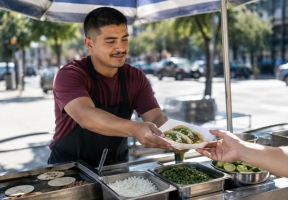 City officials joined the Street Vendors Association of Chicago, Alderman Byron Sigcho-Lopez, and food equity advocates to rally in support of the City’s proposed Mobile Food Carts Licensing Ordinance, which would empower street food vendors to sell prepared foods from mobile food carts on the public way through a new licensing structure.
“Thirty years ago, street vendors started organizing for the opportunity to sell freshly prepared food on the street in Chicago,” said Juan J. Gama, President of the Street Vendors Association of Chicago. “After years of knocking doors, Mayor Johnson gave us the opportunity for this dream to come true, building on the efforts of many who are no longer with us to see the fruits of their struggle. Thank you for giving us the opportunity to get a license.”
Chicago does not currently offer a license that allows entrepreneurs to sell prepared foods from a mobile cart on the public way, making it the only major city with this gap in opportunity for food entrepreneurs. Introduced in Mayor Brandon Johnson’s 2027 Fair Share Budget, the ordinance will allow Chicagoans to apply for a license to sell food and drink that require hot holding, cold holding, preparation, and topping on the public way, an expansion of the current system introduced in 2015 authorizing the sale of pre-packaged food on mobile carts and prepared foods on a food truck.
“Street vendors are interwoven with the fabric of Chicago—selling tamales, elotés, and many other foods that represent our diverse communities,” said Deputy Mayor Beatriz Ponce de León. “While the federal government works to shut doors on immigrant communities, Chicago is opening them. This ordinance is about recognizing the contributions vendors already make to our city and giving them a fair shot to grow their businesses, support their families and contribute to the neighborhoods they call home.”
Under the ordinance, license holders would be required to pay a $500 fee every two years, obtain a Food Service Sanitation Certificate, and complete a health consultation with the Chicago Department of Public Health. Vendors must comply with operational requirements, including move their cart at least every four hours, maintaining clear pedestrian access, and adhering to noise restrictions and required distances from brick-and-mortar restaurants. The legislation would also create the Mobile Food Cart Stands Program, allowing the Chicago Department of Transportation to establish sidewalk stands where food carts can operate at all times or with set hours, with approval of the local alderman, City Council, and a safety determination from the Chicago Police Department.