By: Ashmar Mandou
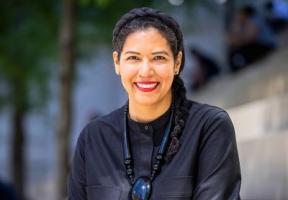 Curator, community organizer, and co-creative director of Chicago Humanities Lauren M. Pacheco is renowned for her work in Slow & Low Festival and the Chicago Urban Art Society for being culturally rich programs. With deep roots in the Pilsen community, Pacheco is now behind Chicago Humanities Festival Pilsen Day where people can explore the Chicano culture and local Latino art. Pacheco spoke to Lawndale Bilingual News about what Chicagoans can expect to see during Pilsen Day, and how she hopes to inspire the next generation.
Lawndale News: How has your 15+ years of experience organizing cultural events such as Slow & Low: Chicago Lowrider Festival and being co-founder of the Chicago Urban Art Society shaped your approach in your latest role as Co-Creative Director for Chicago Humanities, especially being the first Latina Co-Creative Director?
Lauren M. Pacheco: My work has always been rooted in Chicago, its neighborhoods, artists, cultural spaces, and communities. Slow & Low and the Chicago Urban Art Society taught me that cultural programming begins with relationships and trust. They also taught me where something happens, who you invite into the conversation, and whether people feel welcome matter as much as what happens onstage. I carry that thinking into Chicago Humanities. I’m always asking who is part of the conversation, where we’re having it, and what we can create that feels specific to Chicago and the communities we’re working within. Being the first Latina in an artistic leadership position at Chicago Humanities is incredibly meaningful to me. I understand the responsibility that comes with having a seat at the table and helping shape which voices, ideas, and communities are represented. But I also bring more than 20 years of experience as a Chicago artist, curator, and cultural worker to that seat. I think both things matter.
LN: Chicago Humanities Fall Festival Pilsen Day takes place this Saturday at the National Museum of Mexican Art and Thalia Hall. What do you hope resonates with participants the most when touring Pilsen?
LP: I hope people understand that Pilsen isn’t simply the backdrop for the festival. It is part of the experience. For me, that is deeply personal. My family migrated to Pilsen more than 80 years ago, and so much of my own life and cultural work is connected to this neighborhood. My dear friends from high school, Teresa Magaña and Pablo Ramirez, operate Pilsen Arts & Community House. My brother, Peter Kepha, owns and operates Shady Rest Vintage & Vinyl in the heart of the neighborhood. Pilsen is also where Slow & Low was born more than 15 years ago.
So, Pilsen is home, but it is also a neighborhood that has profoundly shaped who I am as a Chicagoan, a Latina, an artist, and a curator. I want visitors to experience its many layers. There are the murals and unique architecture, vintage shops, music, food, galleries, artists, and other small businesses. There is also a long history of organizing and difficult conversations around immigration, development, displacement, gentrification, education, and who gets to remain in and shape a neighborhood. Those histories are part of Pilsen, too. I hope people don’t simply come for a program and leave. Walk around. Visit the museum. Stop in a record store or vintage shop. Look at the buildings and public art. Eat somewhere locally owned. Spend some time understanding the people and histories that have made Pilsen what it is. I want people to experience Pilsen as a living Chicago neighborhood, not simply a destination.
LN: As a Chicago native, with profound roots in Pilsen, how does your cultural heritage and connection to Pilsen influence the creative process of Chicago Humanities Fall Festival Pilsen Day?
LP: I’m a Mexican American woman, born and raised on Chicago’s Southwest Side, and my family’s roots extend across Pilsen, Brighton Park, LeClaire Courts, and Taylor Street. I don’t approach Pilsen as simply another place to put programs. There is a personal history and responsibility attached to doing cultural work here. Our partnership with the National Museum of Mexican Art is especially meaningful to me. My family’s names are on the donor wall at the museum and on bricks at the outdoor performance stage. My relationship with NMMA existed long before my work with Chicago Humanities. It has been part of my family’s cultural life for years. What excites me about our Pilsen Festival Day, particularly the programming at NMMA, is the opportunity to convene people. We’re bringing voices from Texas and Los Angeles to Chicago and putting them into conversation with Chicago audiences, artists, scholars, and moderators. There is something important about creating that kind of exchange. We can connect histories, ideas, music, photography, art, and lived experiences across cities while creating conversations that are very much rooted here in Chicago. My heritage also shapes how I think about gathering, music, public space, storytelling, and how culture and memory are passed from one generation to another. I hope that one day Chicago Humanities can build similar programming and partnerships in other Latino communities across the city. Pilsen can be an important model for what happens when we think about a neighborhood not simply as a venue, but as a partner.
LN: How do you hope these types of festivals and programs open doors and inspire the next generation of Latino/Latinx artists?
LP: My career in the arts really began because I wanted to create a welcoming space for artists and creatives like my brother and longtime collaborator, Peter Kepha. When we established our first gallery in Bridgeport, we wanted to make room for people and creative practices that weren’t always represented in traditional art spaces. We showed multidisciplinary artists, graffiti artists, illustrators, sign painters, found object sculptors, and people working in other unconventional mediums. We also wanted the gallery to be welcoming to people who didn’t necessarily think of themselves as art collectors. You didn’t need a lot of money to walk through the door, appreciate the work, or begin collecting. That experience still shapes how I think about access. Representation matters, but access matters just as much.
I want young Latino artists and cultural workers to see themselves onstage, in museums, behind the scenes, and in leadership positions. But more importantly, I want them to understand that they belong in these spaces. They can create, question, curate, collect, lead, and change these institutions. As a first-generation college graduate, I know how powerful it can be to discover a path that you didn’t necessarily know existed. If some of my work helps make those paths more visible for the people coming next, that matters to me.
LN: This year’s Hispanic Heritage Month theme is “Unidos, Somos Más. Together, We Are More.” How can one incorporate the theme into their daily life?
LP: For me, “Together, We Are More” is about understanding that culture and community are collective. None of us does this work alone.
It doesn’t have to be complicated.
Support a neighborhood business.
Show up for a local artist.
Visit a cultural organization you haven’t experienced before.
Buy someone’s book or artwork.
Share someone’s work.
Introduce two people who should know one another.
Chicago’s neighborhoods hold extraordinary cultural histories, knowledge, and creativity. Being united doesn’t mean having the same story or experience. It means recognizing the value in those differences and understanding what becomes possible when we support one another. That idea of showing up for one another is something we can practice every day.